| 01 |
| Fundamental differences in working principles |
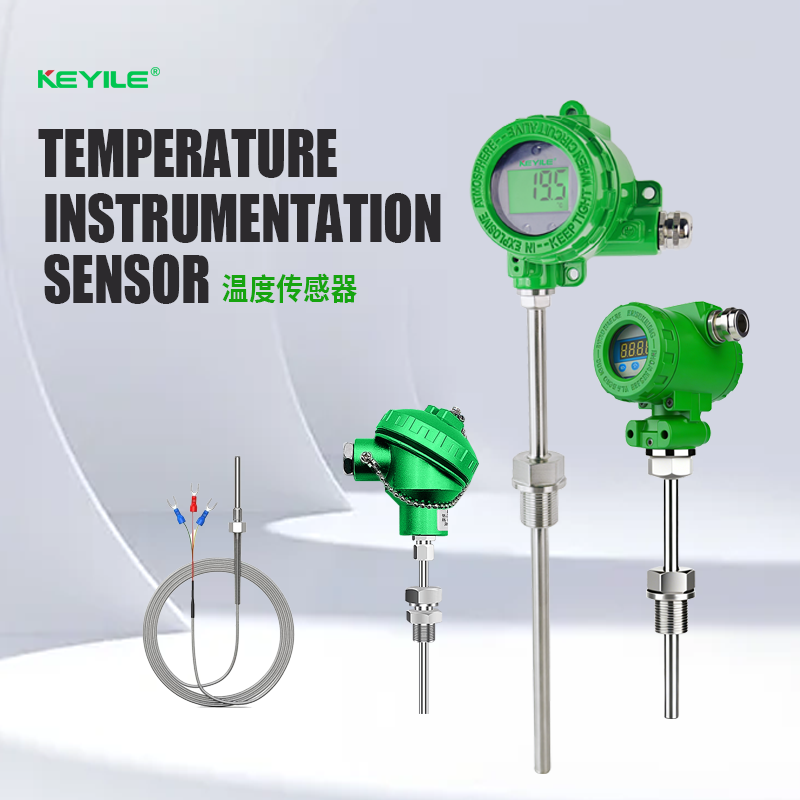
Contact temperature sensor
Contact sensors must be in direct contact with the medium being measured, achieving thermal equilibrium through heat conduction, so that the sensor's temperature-sensing element reflects the temperature of the object being measured.
|
- Representative types: thermocouples, resistance temperature detectors (RTDs) (such as PT100), thermistors, and integrated temperature sensors.
- Core characteristic: Physical contact needs to be established between the sensor and the object being measured.
|
| |
Non-contact temperature sensors
Non-contact sensors do not come into contact with the object being measured. Instead, they calculate the temperature by detecting the infrared energy radiated from the object's surface. |
- Representative types: Infrared thermometers, infrared thermal imagers, fiber optic temperature sensors.
- Core features: Based on thermal radiation theory, they receive and convert infrared energy emitted from the surface of objects.
|
 |
| |
| 02 |
| Performance and Applicable Scenarios Comparison |
1. Response speed
|
- Contact type: Due to the limitations of the heat conduction process, the response speed is relatively slow, especially for objects with large heat capacity, it takes time to reach thermal equilibrium.
- Non-contact: Extremely fast response (millisecond level), can directly detect moving objects or transient temperature changes, suitable for real-time monitoring on high-speed production lines.
|
| 2. Measurement accuracy and influencing factors |
- Contact type: High measurement accuracy (especially for resistance temperature detectors). When in good contact with the object being measured, it can accurately reflect the internal temperature of the object. However, its accuracy is affected by the material properties of the sensor itself and the installation method.
- Non-contact type: Accuracy is greatly affected by emissivity. Different materials have different surface radiation capabilities; if the emissivity coefficient is not set correctly, it will produce large errors. In addition, intermediate media such as smoke, water vapor, and dust can also interfere with the measurement.
|
| 3. Temperature measurement range |
- Contact type: Suitable for the general temperature range (approximately -200°C to 2000°C). In extremely high or low temperature environments, sensor materials and structures may be limited.
- Non-contact type: Theoretically, it has a very high upper limit for temperature measurement (capable of measuring several thousand degrees Celsius), suitable for extreme environments such as high-temperature furnaces and molten steel; it is also suitable for inaccessible low-temperature objects.
|
| 4. Installation and Maintenance |
- Contact Type: Requires insertion into the measured medium or close contact with the surface, which may disrupt the temperature field of the measured object and is susceptible to wear, corrosion, and mechanical impact, requiring regular inspection and replacement.
- Non-Contact Type: Simple installation, no contact with the medium, does not interfere with the measured object, has no risk of wear, and requires less maintenance. However, the optical lens must be kept clean to prevent dust obstruction.
|
| 5. Adaptability to Special Operating Conditions |
- Contact type: Suitable for static objects, internal temperature measurement, and process control requiring high precision (such as pipeline fluids, reaction vessels).
- Non-contact type: Suitable for rotating or moving objects (such as materials on rollers or conveyor belts), high-voltage electrical equipment (such as high-voltage switch contacts), objects with low heat capacity (contact will cause temperature changes), toxic or corrosive environments, and hard-to-reach locations.
|
| 03 |
| Selection advice: How to choose? |
| In practical engineering projects, the choice of sensor type depends on specific operating conditions: |
- If the object being measured is a stationary pipe, liquid, or gas, and high accuracy is required, a contact sensor (such as a PT100 RTD or thermocouple) is recommended.
- If the object being measured is moving, electrified, high-temperature, or cannot be installed in confined space, a non-contact infrared sensor is recommended.
- In some complex operating conditions, both types can be used in combination: for example, a non-contact sensor can be used for rapid scanning to detect temperature anomalies, followed by a contact sensor for precise verification.
|


